Resin 3D printing offers clear benefits for dental workflows, but inhalation exposure to volatile organic compound emissions should be considered alongside dermal exposure for safe clinical and laboratory environments. (Samuel Perales/Adobe Stock)
3D printing using resins has become an important part of dental workflows, but the materials, printer operation and post-processing may pose inhalation risks. This is a major area of focus for US-based safety science organisation UL Research Institutes. A research scientist at its Chemical Insights’ Center for Analytical and Exposure Science, Dr Qian Zhang, recently gave a poster presentation on these risks at the Society of Toxicology 65th Annual Meeting and ToxExpo, held in San Diego in the US. She speaks in this interview with Dental Tribune International about volatile organic compound (VOC) emissions, exposure reduction and the need for safer next-generation materials and systems.
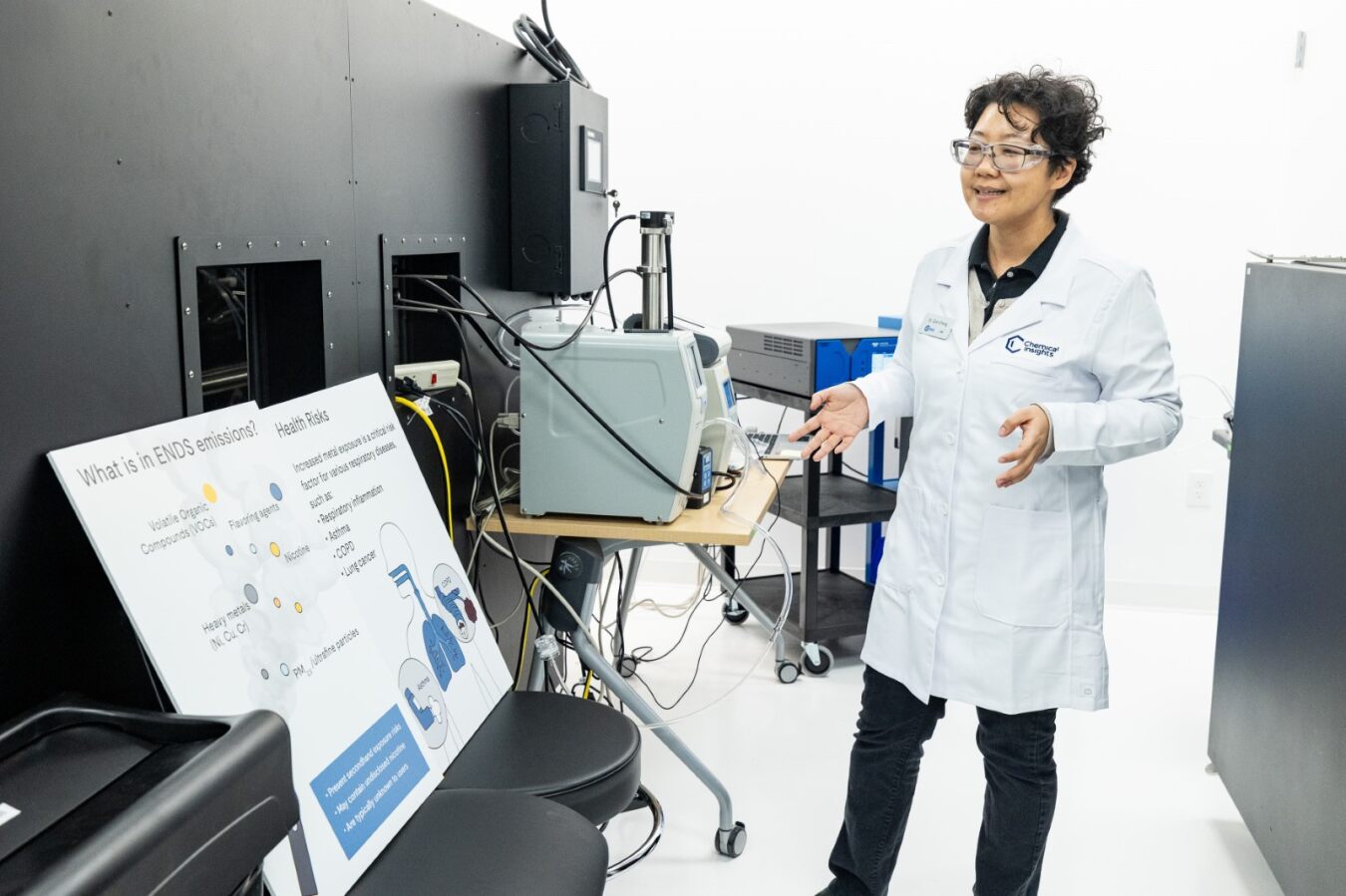
Recent research conducted by Dr Qian Zhang indicates that inhalation exposure to volatile organic compounds from dental resin 3D printing is an under-recognised risk. (Image: Dr Qian Zhang)
Dr Zhang, what are the main inhalation hazards associated with resin 3D printing in dental settings? The main inhalation hazards come from the release of potentially hazardous VOCs associated with resins and with printing and post-processing. Resin materials can off-gas at room temperature, releasing VOCs even when equipment is not in operation. During the 3D-printing workflow, VOC emissions can become more complex as resins undergo chemical and photochemical reactions. Depending on the resin formulation, the VOCs emitted can be irritating and even toxic. Inhalation of toxic VOCs, especially complex mixtures, may pose health risks for those in the environment, particularly employees in dental settings who handle resin materials and operate 3D printers for extended periods.
What does your research suggest about the potential health risks of exposure to emissions from resin 3D printing? We characterised VOC emissions from various dental resins, as well as from the 3D printing process and from the post-processing involved. We identified more than 400 compounds in the emissions and estimated the amounts released for more than 100 of them. We then cross-referenced the chemicals detected with health risk reference tables for compounds with known or potential health concerns. The resin-associated emissions included irritants, reproductive and developmental toxicants, and carcinogens.
We estimated exposure scenarios using modelling calculations and compared them with recommended reference levels. Some toxic compounds exceeded those levels in our estimated worst-case scenario; however, real-world exposure can be more complicated. We also have an ongoing project evaluating the toxicity of resin off-gases and resin 3D-printing emissions using in vitro cell-based tests.
Are current safety protocols in dental practices sufficient to manage these risks, and how much difference do ventilation, local exhaust systems and filtration make? To my knowledge, many safety protocols focus on dermal exposure, since resins typically contain skin sensitisers, whereas inhalation exposure is often overlooked because limited information or guidance is available on potential inhalation risks. Keeping printers and post-processing units closed helps trap emissions inside the devices, but operators and employees may still spend long periods in rooms with these emission sources, so additional control measures are needed.
“Ventilation, dedicated local exhaust systems and filtration are common engineering controls used to lower exposure.”
Ventilation, dedicated local exhaust systems and filtration are common engineering controls used to lower exposure. The aim is to remove contaminants or dilute them in room air and eventually exhaust them outside. In general, each measure, whether used alone or in combination, should reduce exposure levels. However, evaluation and maintenance are needed to confirm the efficacy of these control measures. For example, local exhaust systems should be able to capture contaminants efficiently, and filtration systems should be maintained and have filters replaced when needed.
Which practical safety measures should be standard in every dental 3D-printing set-up? In addition to gloves, which are typically required by resin manufacturers, face shields and laboratory coats should be considered, since uncured resins can drip or splash when resins are loaded or mixed, printed parts are removed and the printing platform is cleaned. Any resin droplets on surfaces outside the printer chamber should be cleaned immediately to avoid continuous off-gassing from uncured resins and accidental contact with skin or clothing. Uncured resins should be stored in sealed containers, and uncured resin waste should be disposed of properly, preferably in sealed containers or under a ventilation hood.
The set-up and workflow are also important. A webcam could be used to check printing status instead of having a person remain close to the printer throughout the process. Printers and post-processing units should be positioned so that emissions can be effectively captured or exhausted, ideally with dedicated local exhaust systems and filtration. Recirculation of emissions into the room or redistribution throughout the building should also be avoided.
Effective ventilation, local exhaust systems, filtration and careful resin handling can help reduce exposure to emissions from resin 3D printing, according to UL Research Institutes scientist Dr Qian Zhang. (Image: Dr Qian Zhang)
What is still unknown about cumulative exposure over time? This is not only an issue for resin 3D printing. In general, we still do not fully understand the effects of exposure to complex chemical mixtures. More studies are needed. One of our research areas is the better prediction of the health impacts of mixtures when evidence is available for individual toxic VOCs.
Our exposure estimates showed a few exceedances of hazardous VOCs in our worst-case scenario in which a person remained close to a running printer with minimal ventilation. Our current study extends these estimates to multiple printers and resins under given room conditions. However, real-world exposure can be more complex because additional emission sources may be present and chemical reactions may occur. Long-term exposure effects still need to be investigated.
What would safer next-generation resins or printer systems need to consider? Emissions are complex and cannot be directly predicted from the raw material formulation. It would be beneficial for manufacturers to include emission testing during product development. Some toxic emissions may be associated with specific components added to raw materials or used in processing steps. If these can be replaced during formulation development, certain contaminants can be removed at the source. For example, isopropanol, a commonly used wash solvent, could be substituted with other solvents, but emission testing would be needed to determine whether the substitutes generate additional contaminants.
Removing emissions at the source would be the most efficient approach. Given the requirements for material properties, if concerning components cannot be replaced, emissions may need to be tested afterwards and reduced where needed. A testing method and emissions standard would help manufacturers promote low-emission and safer products, as well as help users choose suitable products based on their needs and settings.
JINAN, China: 3D printing of lithium disilicate still faces challenges in achieving precise results. The material’s high transparency allows laser light ...
At the seventh European Aligner Congress, discussions around aligner materials and digital workflows highlighted a question of growing relevance to ...
At IDEM Singapore 2026, American Board-certified prosthodontist and oral rehabilitation specialist Dr Anas Aloum will discuss how digital workflows are ...
MUNICH, Germany: Additive manufacturing is rapidly gaining importance in removable prosthodontics. To inform clinicians, a recent review has provided an ...
CUXHAVEN, Germany: Dental products manufacturer VOCO and 3D printer manufacturer Formlabs have announced a new partnership that enables VOCO’s V-Print ...



 International / International
 Brazil / Brasil
 Canada / Canada
 Latin America / Latinoamérica
 USA / USA
 Austria / Österreich
 Bosnia and Herzegovina / Босна и Херцеговина
 Bulgaria / България
 Croatia / Hrvatska
 Czech Republic & Slovakia / Česká republika & Slovensko
 France / France
 Germany / Deutschland
 Greece / ΕΛΛΑΔΑ
 Hungary / Hungary
 Italy / Italia
 Netherlands / Nederland
 Nordic / Nordic
 Poland / Polska
 Portugal / Portugal
 Romania & Moldova / România & Moldova
 Slovenia / Slovenija
 Serbia & Montenegro / Србија и Црна Гора
 Spain / España
 Switzerland / Schweiz
 Turkey / Türkiye
 UK & Ireland / UK & Ireland
 China / 中国
 India / भारत गणराज्य
 Pakistan / Pākistān
 Vietnam / Việt Nam
 ASEAN / ASEAN
 Israel / מְדִינַת יִשְׂרָאֵל
 Algeria, Morocco & Tunisia / الجزائر والمغرب وتونس

 Dr. Ronald JungLive webinar
 Prof. Aylin Baysan BDS MSc PhD MFDS RCSEd MEndo RCSEd FDTFEd FDS RCSEng PHEARegister now1CELive webinar
 Prof. Dr. Gustavo De-DeusLive webinar
 Dr. Dimple DesaiRegister now1CE












To post a reply please login or register