Adjacent teeth damaged by dental bur
Objective
Cutting and finishing approximal preparations with conventional instrumentation and methods may produce iatrogenic damage in adjacent tooth surfaces which subsequently requires restoration. The objective of this investigation was to determine the occurrence of iatrogenic damage and whether, under everyday working conditions in dental practice, such damage could be reduced significantly by using an alternative method and instrumentation designed especially for the purpose.
Method
Dental practitioners were asked to take impressions of teeth scheduled for Class II amalgam restorations. One group (control) prepared the teeth with conventional rotary instrumentation (n = 71), while the test group used a new method and instrumentation (n = 63). These comprised a set of files, a rightangle handpiece with reduced stroke, 36 fixed (rotation-locked) positions for the files and a cylindrical bur with a recessed front-end cutting surface.
Damage to the adjacent teeth was assessed under a stereomicroscope.
1 Palodent® Plus was re-branded to Palodent® V3 in 2015.
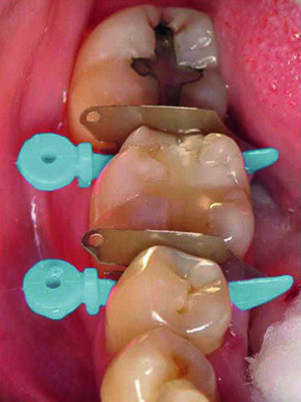
Insert Palodent® V31 WedgeGuard before starting preparation
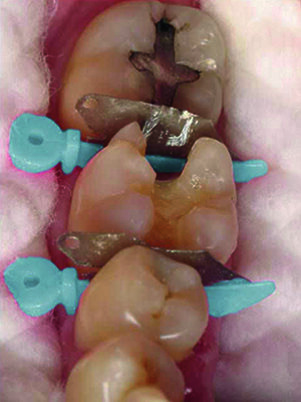
WedgeGuard protects adjacent tooth during preparation
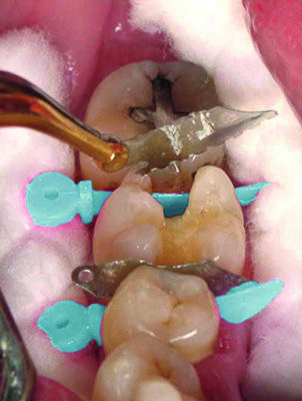
Remove plate from WedgeGuard, wedge remains
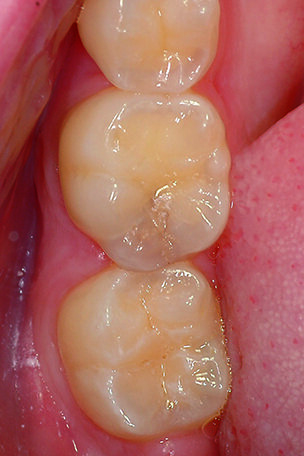
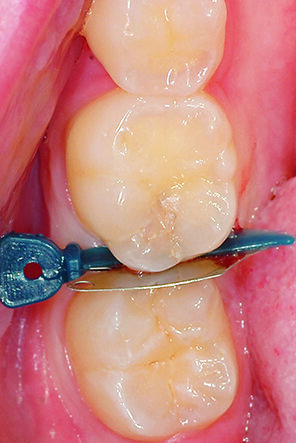
Initial Case. Proximal caries on the distal area of the first lower molar.
Insertion of the Palodent® V3 WedgeGuard before tooth preparation.
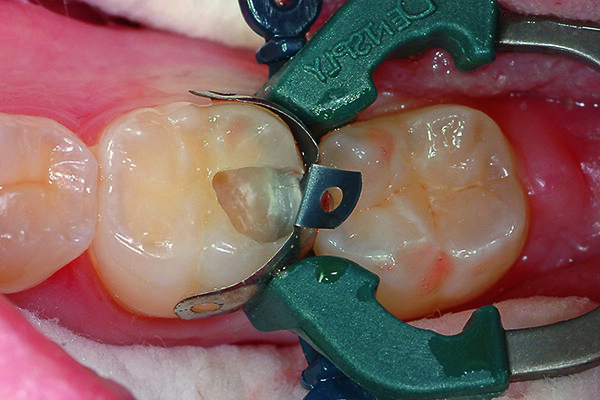
Cavity preparation and the Palodent® V3 system in place.
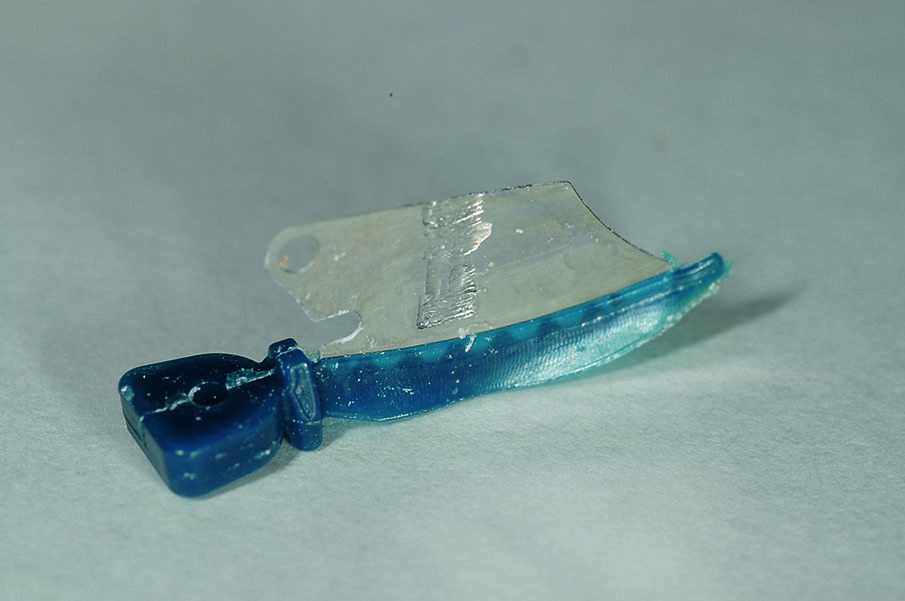
Palodent® V3 WedgeGuard showing damage caused to the WedgeGuard (and not the adjacent tooth) after tooth preparation.
Results
Using conventional methods, all adjacent tooth surfaces showed damage, often exposing deep layers of dental tissues. There was a clinical and statistically significant reduction of incidence and severity of iatrogenic preparation trauma in the test group.
Conclusion
It appears that conventional approximal box preparation results in significant damage to adjacent tooth surfaces. With the system tested, damage to adjacent tooth surfaces during preparation of proximal boxes can be significantly reduced. This should have an impact on the subsequent rate of restoration for the adjacent surfaces.
In this article Dr. Thomas Zumstein presents a Neoss implant case that has been in function for more than 11 years. The case shows that long-term success ...
Female patient, 47 years old, presented with a clinical picture of extensive iatrogenic perforation of the furcation region of the dental element 36 (Figs. ...
A 43 year old female came to my practice with a history of non-attendance. She was concerned about generalised sensitivity with her heavily-restored ...
Every year, dental undergraduate and graduate students, with less than 2 years of clinical practice, are invited to participate by documenting a patient ...
Molar incisor hypomineralisation (MIH) is a relatively common dental defect that appears in first permanent molars and incisors and varies in clinical ...
A 50-year-old male patient presented for professional tooth cleaning. He had deep erosive lesions affecting the vestibular aspects of his maxillary central ...
Osstem Implant, the world’s No. 1 implant sales company, invites 1,500 dentists from 22 countries, including China, Japan, Germany, and Australia, to its ...
PERTH, Australia: Researchers in Australia have recently received government funding for a project that aims to develop a system that would allow parents to...
A 35-year-old female patient expressed a desire to optimize existing composite restorations on her maxillary central incisors, which had been placed 15 ...
After almost ten years, the leading composite veneering system shines with a new brilliance: the customisable BRILLIANT COMPONEER composite shells have been...
Live webinar
Fri. 16 October 2026
1:00 pm UAE (Dubai)
Prof. Dr. Dr. Florian Stelzle
Live webinar
Mon. 19 October 2026
9:00 pm UAE (Dubai)
Live webinar
Mon. 19 October 2026
9:00 pm UAE (Dubai)
Live webinar
Tue. 20 October 2026
8:00 pm UAE (Dubai)
Live webinar
Tue. 20 October 2026
9:00 pm UAE (Dubai)
Prof. Aylin Baysan BDS MSc PhD MFDS RCSEd MEndo RCSEd FDTFEd FDS RCSEng PHEA
Live webinar
Wed. 21 October 2026
7:00 pm UAE (Dubai)
Prof. Dr. Gustavo De-Deus
Live webinar
Wed. 21 October 2026
8:00 pm UAE (Dubai)
Nora-Sophie Feulner DH, B. Sc.



 International / International
 Brazil / Brasil
 Canada / Canada
 Latin America / Latinoamérica
 USA / USA
 Austria / Österreich
 Bosnia and Herzegovina / Босна и Херцеговина
 Bulgaria / България
 Croatia / Hrvatska
 Czech Republic & Slovakia / Česká republika & Slovensko
 France / France
 Germany / Deutschland
 Greece / ΕΛΛΑΔΑ
 Hungary / Hungary
 Italy / Italia
 Netherlands / Nederland
 Nordic / Nordic
 Poland / Polska
 Portugal / Portugal
 Romania & Moldova / România & Moldova
 Slovenia / Slovenija
 Serbia & Montenegro / Србија и Црна Гора
 Spain / España
 Switzerland / Schweiz
 Turkey / Türkiye
 UK & Ireland / UK & Ireland
 China / 中国
 India / भारत गणराज्य
 Pakistan / Pākistān
 Vietnam / Việt Nam
 ASEAN / ASEAN
 Israel / מְדִינַת יִשְׂרָאֵל
 Algeria, Morocco & Tunisia / الجزائر والمغرب وتونس

 Dr. Ronald JungLive webinar
 Prof. Aylin Baysan BDS MSc PhD MFDS RCSEd MEndo RCSEd FDTFEd FDS RCSEng PHEARegister now1CELive webinar
 Prof. Dr. Gustavo De-DeusRegister now1.5CELive webinar
 Dr. Dimple DesaiRegister now1CE