Should you reprocess and reuse, or pitch after each patient? Learn what to consider when choosing between single or multi-use products in a post-COVID environment.
There’s more to infection control than masks and hand sanitizer. It’s time to take a closer look at consumables: reuse and reprocess, or go disposable?
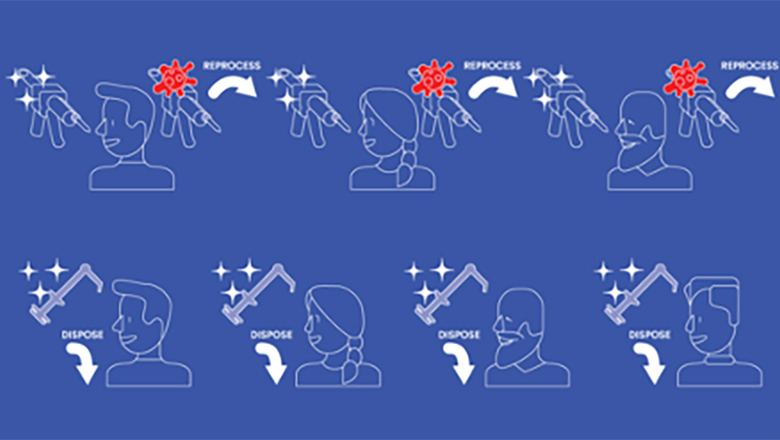
Nonetheless, products under each umbrella can be reprocessed safely.After use, non-critical items should be cleaned, and then disinfected if the product is visibly soiled.Guidelines indicate that heat-tolerant, semi-critical dental products should be heat sterilized.The CDC recommends that heat sensitive, semi-critical products should be reprocessed using high level disinfection or replaced with a disposable alternative.The FDA has published an additional guidance for multiple use intra-oral dental dispensers, such as those that deliver adhesive or composite materials.2It states that these devices that cannot be sterilized or high level disinfected based upon their design must be covered with a barrier sleeve during use to prevent contact with mucous membranes. Multi-use critical products, on the other hand, must always be sterilized between patient uses.
Post-COVID, everything will change – from your approach to PPE and scheduling patients, to the procedures you perform. But should your products change too? One factor you may be considering is when to incorporate a single-use solution and when to stick with multi-use delivery. Let’s take a closer look at infection prevention, product choices and what you may choose to change in a post-COVID dental setting. The CDC classifies product infection risk on a scale of non-critical to critical. Non-critical products pose the lowest risk, as they only encounter intact skin, which acts as a barrier to most microorganisms. Semi-critical products are those that are used intra-orally or on non-intact skin, increasing the risk of infection. Critical products are considered high risk, as they’re used to penetrate soft tissue or bone. The infection risk is lowest when it comes to non-critical products and highest when it comes to critical products.1
According to the CDC, dental offices should consider adopting single-use products when they replace multi-use, semi-critical products that cannot tolerate heat sterilization.3 The guidelines also indicate that similarly classified, multi-use products may be used safely if the manufacturer’s reprocessing instructions are followed correctly.
But why should you consider single-use products and delivery systems? Single-use products take the risk of patient-to-patient infection out of the equation – infection control is baked into the product design. Of course, the risk of patient-to-patient transmission is also addressed when a multi-use device has been appropriately reprocessed. But if it gives you peace of mind, or if you think it may give your patients confidence, replacing multi-use products that are routinely used intraorally with single-use alternatives may be the right way to go.3
Further, the CDC advises that offices should consider not just the initial product cost of a single-use item, but also the time, cost and material savings obtained by eliminating the need for sterile processing of that product.3 At a time when so many procedures and protocols have ratcheted up and your office workflow is almost unrecognizable, every factor – from expenses to application needs to infection risk – is worth exploring.
Dental products, of course, are not one-size-fits all. Variables like application needs, ergonomic or control considerations, and more may well be worth reprocessing a multi-use version of a product rather than switching to a single-use option.
Before making a commitment to adopting single-use products, allow these considerations to guide your decision-making process:
Consider replacing heat-sensitive products that encounter the intra-oral environment with single-use options
Single-use products eliminate the risk of cross contamination between patients
Single-use products may increase efficiency by reducing reprocessing time and effort
Multi-use products can also be used safely by following appropriate reprocessing protocols
As precautionary measures are adapted across different professions in the wake of the COVID-19 outbreak, dentists are being extra cautious to protect ...
The long-awaited post-pandemic recovery and reopening of dental practices for patients after the COVID-19 pandemic has not only produced a spike in the ...
LEIPZIG, Germany: Even though millions of people suffer from anxiety and depression, according to the World Health Organization, psychiatric disorders often...
AL-NABEK, Syria: Years of conflict have left deep psychological scars on Syria’s future healthcare workforce. New research among health sciences students ...
AL-AIN, UAE: According to the World Health Organization, 60 to 90 per cent of schoolchildren worldwide have dental cavities. Tooth decay, which can have a ...
Managing the carious primary molar in children using the “Hall Technique” is a controversial but acceptable novel method. Restoring all eight carious ...
Established in 1962, Schütz Dental has a long-standing reputation for innovation and customer-focused solutions. Headquartered in Germany, the company has ...
32DentalDesigns by Medikabazaar, a pioneering force in dental laboratory technology, celebrated a momentous occasion on Monday 14th August 2023, marked by ...
With his extensive experience in using and reviewing scanners, and as the founder of the Institute of Digital Dentistry (iDD), Dr Ahmad Al-Hassiny is well ...
RAS AL-KHAIMAH, UAE: Although the association between dental anxiety and oral health-related quality of life is well established internationally, evidence ...
RIYADH, Saudi Arabia: Although aligners can achieve occlusal improvements comparable to those of fixed appliances in selected cases, evidence is less ...
SHARJAH, UAE: Recent evidence suggests that tooth wear is becoming both more prevalent and more severe among adolescents worldwide, but prevalence in the ...
In its 75th year, the International Association of Dental Students (IADS) is looking beyond clinical education to strengthen the voice of dental students ...



 International / International
 Brazil / Brasil
 Canada / Canada
 Latin America / Latinoamérica
 USA / USA
 Austria / Österreich
 Bosnia and Herzegovina / Босна и Херцеговина
 Bulgaria / България
 Croatia / Hrvatska
 Czech Republic & Slovakia / Česká republika & Slovensko
 France / France
 Germany / Deutschland
 Greece / ΕΛΛΑΔΑ
 Hungary / Hungary
 Italy / Italia
 Netherlands / Nederland
 Nordic / Nordic
 Poland / Polska
 Portugal / Portugal
 Romania & Moldova / România & Moldova
 Slovenia / Slovenija
 Serbia & Montenegro / Србија и Црна Гора
 Spain / España
 Switzerland / Schweiz
 Turkey / Türkiye
 UK & Ireland / UK & Ireland
 China / 中国
 India / भारत गणराज्य
 Pakistan / Pākistān
 Vietnam / Việt Nam
 ASEAN / ASEAN
 Israel / מְדִינַת יִשְׂרָאֵל
 Algeria, Morocco & Tunisia / الجزائر والمغرب وتونس

 Dr. Dimple DesaiRegister now1CELive webinar
 Dr. Ahmed ElmoghazyLive webinar
 Dr. Gil Asafrana D.M.D, B.M.ScRegister now1CELive webinar
 Dr. Adrian Gnatek PhD | Oral SurgeonRegister now1CE